
When you apply for a bank loan, one simple question can decide how much you pay in the long run.
Should you choose a fixed interest rate or a floating interest rate?
Many people answer this without fully understanding the impact. Years later, they realize they have paid a huge amount just as interest.
It is common to see borrowers take a loan of LKR 10 million and end up paying more than LKR 20 million in total. Most of that extra money goes to the bank as interest.
Before you make that decision, it is important to understand how these options really work.
Why Many Borrowers Feel Trapped After a Few Years
In the beginning, the monthly installment looks manageable. Everything seems under control.
After a few years, you check your loan balance and feel surprised. Even after paying for a long time, the loan amount has not reduced much.
This happens because, in the early years, a large portion of your payment goes toward interest rather than the actual loan amount.
Understanding this early can help you avoid that situation.
Fixed vs Floating Interest: How to Choose the Right Option
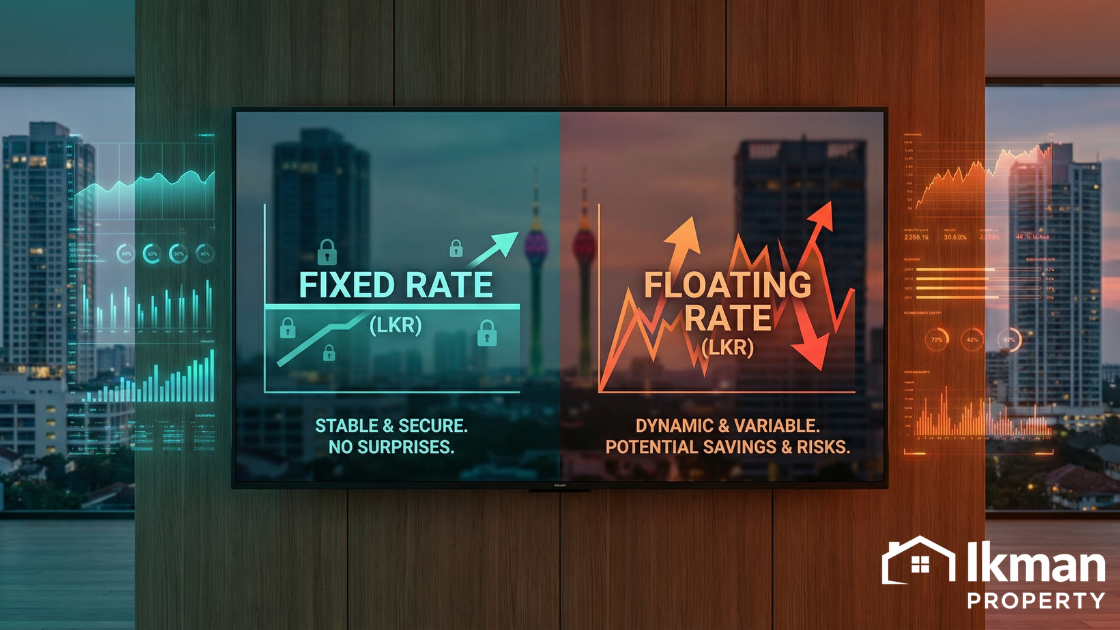
Fixed Interest Rate
A fixed rate means your interest stays the same for a certain period.
This works well when interest rates in the market are already low. If rates increase later, your payment will not change.
It gives stability and makes it easier to plan your finances.
Floating Interest Rate
A floating rate changes based on market conditions.
This is a better option when interest rates are high at the time you take the loan. If rates go down later, your monthly payment can also reduce.
However, there is always some uncertainty, as rates can increase again.
When to Choose Each Option
- If market interest rates are low, fixing your rate for a few years can protect you
- If market rates are high, a floating rate gives you a chance to benefit when rates drop
Making the right choice depends on timing and market conditions.
A Smart Strategy Most Borrowers Ignore: Balance Transfer
Many people continue paying high interest even when rates in the market have dropped.
You do not have to stay with the same bank.
If your current loan has a high interest rate and other banks are offering lower rates, you can transfer your loan to another bank. This is known as refinancing.
By doing this, you can reduce your interest rate and save a significant amount over time.
How to Reduce Your Loan Faster
Banks earn more when you keep paying interest for a long time. That is why many borrowers only stick to the monthly installment.
A better approach is to reduce your loan balance whenever possible.
If you receive extra income, such as a bonus or additional earnings, use part of it to reduce the principal amount.
Even a single extra payment can lower your future interest and shorten your loan period.
Talk to Your Bank and Negotiate
Many borrowers do not realize this. You can actually speak to your bank and request a lower interest rate.
If your current rate is high compared to the market, you can ask for a revision. You can also mention that you are considering moving your loan to another bank.
Banks usually prefer to keep existing customers, so they may offer a better rate.
A Practical Tip for Loan Holders
Take a moment and review your loan agreement.
Check your current interest rate. If it is significantly higher than what is available in the market, it may be time to take action.
Ignoring it means you continue paying more than necessary.
Conclusion
Choosing between fixed and floating interest is not a small decision. It directly affects how much you pay over the years.
Understanding how interest works, reviewing your options, and taking action at the right time can save you a large amount of money.
The goal is not just to take a loan, but to manage it wisely.
Disclaimer
This article is for general informational purposes only. Interest rates and loan conditions can change based on market conditions and central bank policies. Always consult your bank or a qualified financial advisor before making any decisions related to loans or refinancing.